

Into Rosemary Thorp’s world
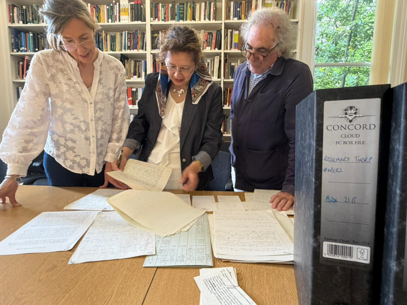
Grace Jaramillo LAC visiting fellow), Rebeca Otazúa (LAC Librarian) and Eduardo Posada-Carbó look at a sample of Rosemay Thorp archives kept in our library at the LAC.
Grace Jaramillo, Lecturer at University of British Columbia’s School of Public Policy and Global Affairs in Canada, reflects on the work she undertook on Rosemary Thorp’s papers as visiting fellow at the LAC in 2026.
Into Rosemary Thorp’s world
Rosemary was most remembered as a Peruvianist thanks to the seminal contributions alongside Geoffrey Bertram, Lawrence Whitehead, Francisco Durand, Maritza Paredes and others. However, it is not far-fetched to say that the economic history of the Andean Region became a whole field of study because of her. One of the first to collect primary sources, statistics, conversation minutes and her dedication to read all and every report there was about economic growth, development, poverty and inequality, sometimes calculating data herself, from scratch put her into a different level all together.
Evidence of this encyclopaedic trait become evident during my stay as visiting fellow at Oxford’s Latin American Centre the year 2026. I had the honour of becoming the first user of the Rosemary Thorp Collection, until then an unexplored archive that rests in the Bodleian’s Latin American Library, where I worked every working day for six months to finish the manuscript of my book Industrial Policy in the Andean Region: The cases of Peru and Ecuador. I knew about the existence of Rosemary’s collection from a colleague and friend at Oxford, Diego Sánchez-Ancochea, who was my host at University of Oxford.
Exploring Rosemary’s unpublished documents became a central part of my journey. The collection of 23 boxes with material from 1957 onwards contain primary statistics and reports from regional and multilateral banks, mainly from Colombia and Peru but also from Bolivia, Mexico and Venezuela.
I had a clear objective going into Rosemary’s archives: identify primary information for Colombia and Peru’s industrial policy history before the 1980s. I was looking for decisions about tariffs, subsidies but also Rosemary’s own calculations that were prevalent in the books about Peru. I was also looking for unpublished notes and comments about economic or sectoral policy in the Andean region during the ending peak of Import Substitution Industrialization in Latin America. Her archives did not disappoint. If anything, they revealed insightful observations about the discussions and considerations national officials and international experts were having about the outcomes of those policies.
The most impressive documents coming out from this collection are original manuscripts -either articles or reports- from fellow scholars and students where Rosemary inserted commentaries, suggestions and additional notes. There is for instance, a handwritten note next to a mimeo from one of the most prominent Colombian economists, José Antonio Ocampo, that -among other things- says: “J.A. Ocampo, promising,” an endearing note if we think it was written back in 1966.
I found additional evidence for this particular trait of her incredible dedication and stamina. In at least three boxes, there are exhaustive notes and comments of specific reports by the IMF, World Bank and Inter-American Development Bank with comments and added notes on how these reports and the recommendations they provided are detrimental to sectorial policies and to welfare ones. It clearly paved the way for her turn One could ask what the usefulness of all those notes and insights today’s scholarship of the Andes is. The answer is plenty. Rosemary Thorp wrote incessantly and to move others to follow in her steps with wider and deeper research questions. Her archival is an endearing lesson of passion, perseverance and true dedication to deep questions about development, growth, inequality, job and value creation, economic justice and policies that can lift people out of poverty.
Rosemary Thorp was a force of nature. Her archive is an additional legacy to incite new lines of inquiry from old notes, inquiries about development and exclusion that are still unanswered and unfulfilled in Latin America as much as in the rest of the world. The Latin American Centre is the most welcoming space for such exploration and a wonderful starting point to honour Rosemary Thorp with a similar scholarly passion.

